


Disclosure: this article contains affiliate links to Infomaniak. If you sign up for a paid service through them, I earn a small commission. It costs you nothing extra, and the full note is at the bottom.
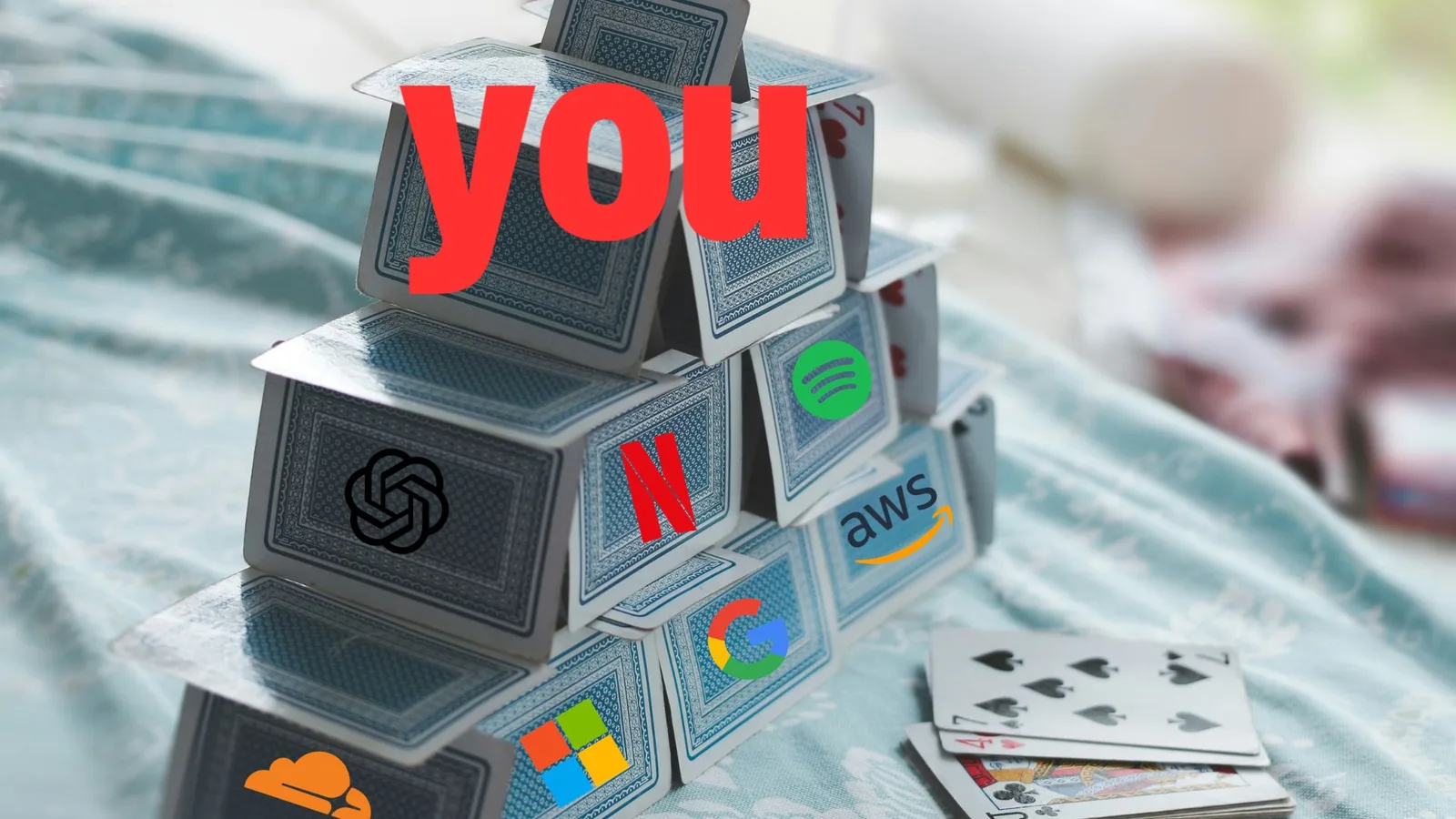
Microsoft, Google, Amazon and Cloudflare are the companies that make up the internet as most of us use it. Whatever you open in a day, Netflix or ChatGPT or your company’s email, the odds are good that one of them is carrying it. That is a long way from what the internet was built to be, and this week’s Microsoft outage shows what it costs.
Built So That Nothing Was Indispensable
Before the World Wide Web existed, the network underneath it was designed around decentralisation. No single machine or organisation was meant to matter so much that its failure would take everything else down with it. Resilience was part of the design.
The domain name system is a good example. It works like a phone book: you type a website’s name, and it looks up the number, the IP address, that your computer has to dial. It was built with redundancy in many places. Much of that redundancy is lost once a large share of the world’s traffic runs through one company.
That is what happened on 18 November 2025. A change to the permissions on one of Cloudflare’s database systems doubled the size of a file its software reads. The file was copied to every machine in Cloudflare’s network, and the software failed (Cloudflare). People trying to reach websites that use Cloudflare got an error page instead.
It Does Not Take an Attack
Cloudflare says plainly that its outage was not a cyber attack. Attacks are frequent, and they get the headlines, but a system this concentrated does not need an attacker. A process can run away through ignorance, arrogance or plain stupidity, and the effect is the same. I see caution thrown to the wind a lot at the moment, and the AI companies, OpenAI and Anthropic among them, are some of the worst for it.
Amazon, Alphabet and Microsoft between them expect to spend roughly $595 billion on data centres and other capital projects this year, most of it driven by demand for AI (The Register). Much of the AI industry runs on their machines. Our banking, our jobs and the economy at large rely on the internet working, and more and more of the internet relies on those three.
Microsoft’s Week
Microsoft 365 started failing on Thursday, and on Friday I wrote about what to do while it is down. When email, calendars and Teams stop for days, the work stops with them, and the cost to the economy adds up fast.
A week before the outage, on 5 November, Microsoft announced that it is retiring Office 365 A1, the free licence many schools run on. Its free replacement, A0, leaves out email, Teams and SharePoint. The change reaches each school at its first contract renewal on or after 1 January 2028 (LazyAdmin).
For UK schools that built their working day on a free Microsoft licence, that looks to me like a bait and switch. Academy trusts are already short of money. Paying many thousands of pounds for licences they used to get free will cut into everything else they do.
Public Services Run on the Same Internet
HMRC, Universal Credit and the Department for Work and Pensions all depend on the internet working. If they cannot do their job because basic messaging is down, a great many people could miss a benefit payment or a tax rebate, or be unable to file a return on time. What happens then? I would expect penalties to follow. That is my guess, not something I have seen happen.
Europe Started Leaving Years Ago
Many of our European neighbours reached this conclusion years ago. They decided that their basic needs, such as email and file storage, should not depend on a handful of companies based somewhere else, and they have been moving to open-source software, much of it with commercial support from European firms.
- Schleswig-Holstein, in northern Germany: almost 80% of state government workplaces outside the tax administration have moved from Microsoft Office to LibreOffice. The state expects to save more than €15 million in licence costs in 2026, against a one-off investment of €9 million (It’s FOSS).
- Denmark: the Ministry of Digital Affairs is moving from Microsoft to LibreOffice, and Copenhagen and Aarhus, two of the country’s biggest municipalities, are ending their use of Microsoft systems (UC Today).
Weeks like this one make their case more urgent. The alternative is open-source software, or at the least a provider you have chosen yourself and could leave.
My Own Server Is Not Enough
I run my own mail server, so I do not worry about my email going down when Google’s or Microsoft’s does. I worry about my customers. If their email is on Microsoft 365 and Microsoft 365 is down, my messages do not reach them, and theirs do not reach me. Being self-sufficient on my own helps less than I would like.
So this is partly a message to my clients: take this seriously. There are better options, and in a lot of cases they cost less and give you more flexibility as well as more control. Infomaniak and Fastmail both run a dependable service a business can rely on, at a modest licence cost, and you can get support from people like me. I compared more European providers in an earlier article, and I run a mail service of my own for clients.
The Bottom Line
The internet was designed to survive the loss of any one part, and we have rebuilt much of it on four companies, none of them based in the UK. Look at your own setup and ask what would still work if one of them went down tomorrow. If you do not like the answer, that is something I can help you change.
What’s Your Experience?
Which of the four would stop your business if it failed tomorrow, and have you planned for it? Tell me through social media.
If you want to know how resilient your own setup is, book a call.
Disclosure
I moved from Google Workspace and Microsoft 365 to Infomaniak’s kSuite, and I have been happy enough with it to become an affiliate. Links to Infomaniak in this article carry a reference to me, and if you sign up for one of their paid services, I earn a small amount. It makes no difference to what you pay, and it is not why they are my recommendation. I switched first and signed up as an affiliate afterwards.
Photo by Compagnons on Unsplash, edited to add the logos
